
Konnichiwa! I’m Kaori.
If there is one topic that makes my friends from abroad the most nervous about visiting Japan, it is undoubtedly the Onsen (hot spring).
I understand why. In most of the world, bathing is a private act. The idea of stripping down completely naked in front of strangers feels vulnerable, perhaps even terrifying. But growing up in Kyoto, the bathhouse was my second home. I remember holding my grandmother’s hand as we walked to our neighborhood Sento, the sound of wooden buckets clanking against the tile floor, and the thick steam smelling faintly of sulfur and soap.
To us, bathing isn’t just about washing dirt off your skin. It is about Hadaka no tsukiai—”naked communion.” When you remove your clothes, you remove your status, your job title, and your defenses. In the steam, everyone is equal.
Living in the high-speed rush of Tokyo now, I crave this escape more than ever. But I also see many tourists making unintentional mistakes—wearing swimsuits where they shouldn’t, dipping towels in the water, or rushing through the process.
Please don’t worry. I am here to walk you through every single step, from the shoe locker to the final sip of cold milk. If you are planning your first trip to Japan, consider this your essential crash course in our most beloved tradition.
The Philosophy of the Bath: It’s Not Just About Getting Clean
Before we talk about how, we must understand why.
In the West, a shower is often a chore—something efficient to do before work. In Japan, the bath (Ofuro) is a ritual of separation. It separates the day’s stress from your evening peace. It separates the outside world from your inner sanctuary.
When you visit an Onsen, you are participating in a practice called Toji (healing). The water contains minerals—sulfur, iron, sodium—that soak into your body. If you rush in and out, you miss the healing. The goal is to slow down.
Essential Onsen Vocabulary (Speak Like a Local)
You don’t need to be fluent in Japanese, but knowing these words will help you navigate the signs.
- Onsen (温泉): Natural hot spring water (must be geothermally heated and contain minerals).
- Sento (銭湯): A public bathhouse using heated tap water (often found in cities).
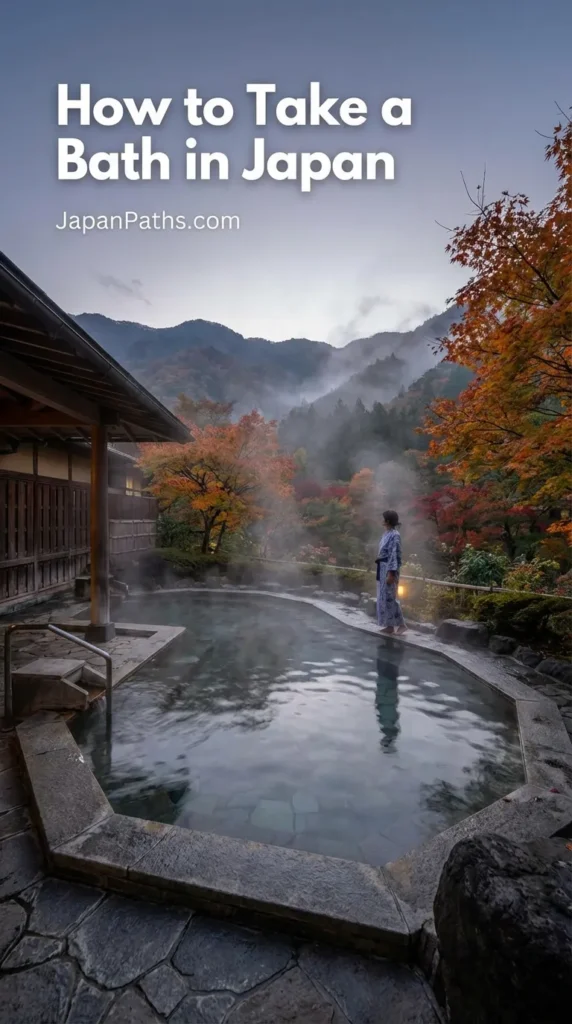
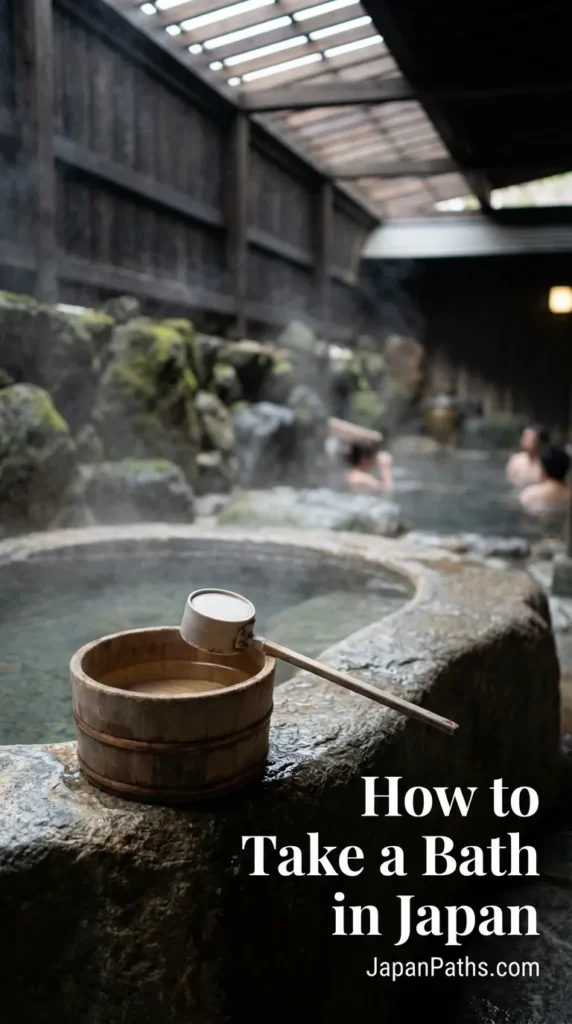
- Rotenburo (露天風呂): An open-air outdoor bath (my absolute favorite—there is nothing like cold air on your face while your body is hot).
- Kakeyu (かけ湯): The act of splashing water on yourself before entering the bath.
- Yu-agari (湯上がり): The feeling/state of just having finished a bath.
- Konyoku (混浴): Mixed-gender baths (very rare these days, mostly in rural mountains).
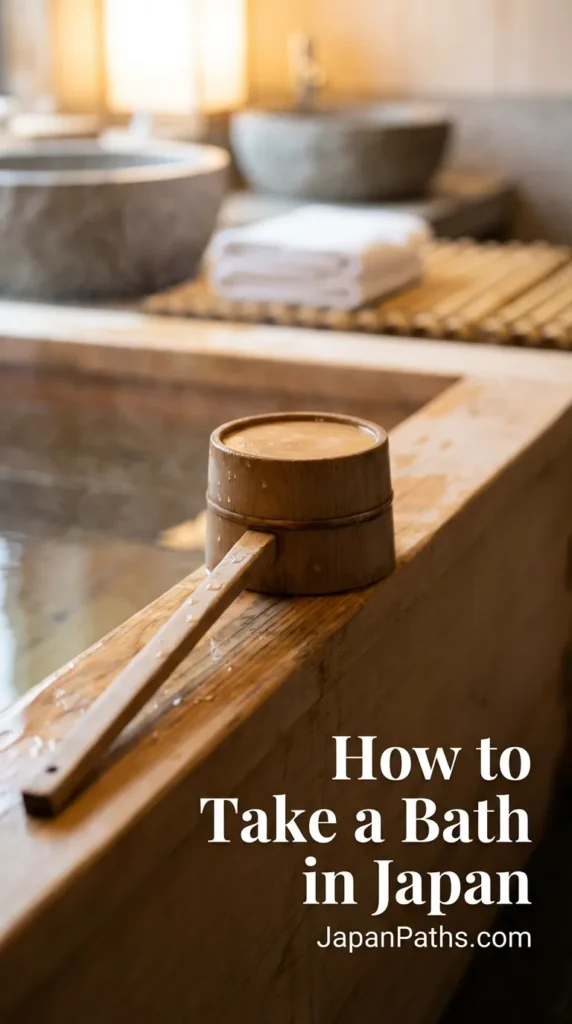
What to Bring (and What to Leave Behind)
Most modern Onsen and Ryokans provide almost everything, but here is my personal packing list.
What to Bring:
- Hair Tie: If you have long hair, this is non-negotiable. Your hair must not touch the bathwater.
- Small Coin Purse: You might need 100-yen coins for the shoe locker or the post-bath milk vending machine.
- Skincare: While they provide basics, I always bring my own moisturizer because the hot water can be drying.
What is Usually Provided:
- Shampoo, Conditioner, Body Soap: Found at every washing station.
- Towels: High-end Ryokans provide them. Public Sento might rent them for 200 yen. You will get two: a Large Bath Towel (for drying off at the end) and a Small Face Towel (the “modesty” towel).
What to Leave in Your Room:
- Swimsuit: Unless it is a specific “bathing suit zone” (like some water parks), swimsuits are strictly forbidden.
- Phone/Camera: Absolutely never take these into the changing room or bath. It is a severe privacy violation.
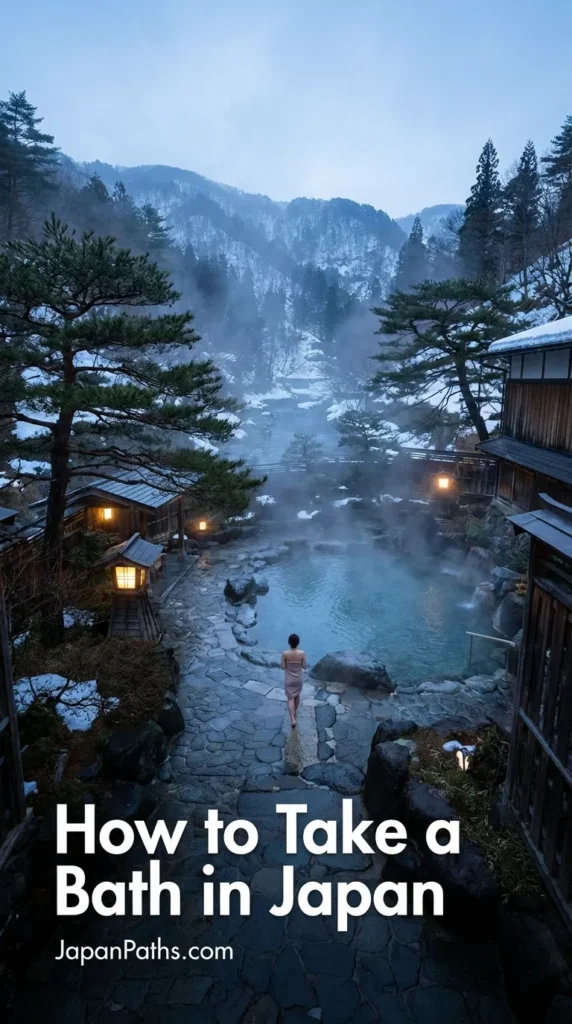
Step-by-Step: The Authentic Onsen Ritual
Let’s walk through the process together. Imagine we have just arrived at a beautiful Ryokan in the mountains.
Step 1: The Entrance (Noren Curtains & Shoe Etiquette)
You will see two curtains (Noren) hanging in front of the bath entrances. Do not mix these up!
- Red/Pink Curtain (女): For Women (Onna).
- Blue/Navy Curtain (男): For Men (Otoko).
Kaori’s Tip: Always double-check the Kanji! Sometimes facilities swap the men’s and women’s sides in the morning and evening so everyone can enjoy different views. If you go on autopilot, you might walk into the wrong room!
Once inside, take off your slippers or shoes immediately. There will be a locker or shelf. Do not step on the tatami or changing floor with shoes.
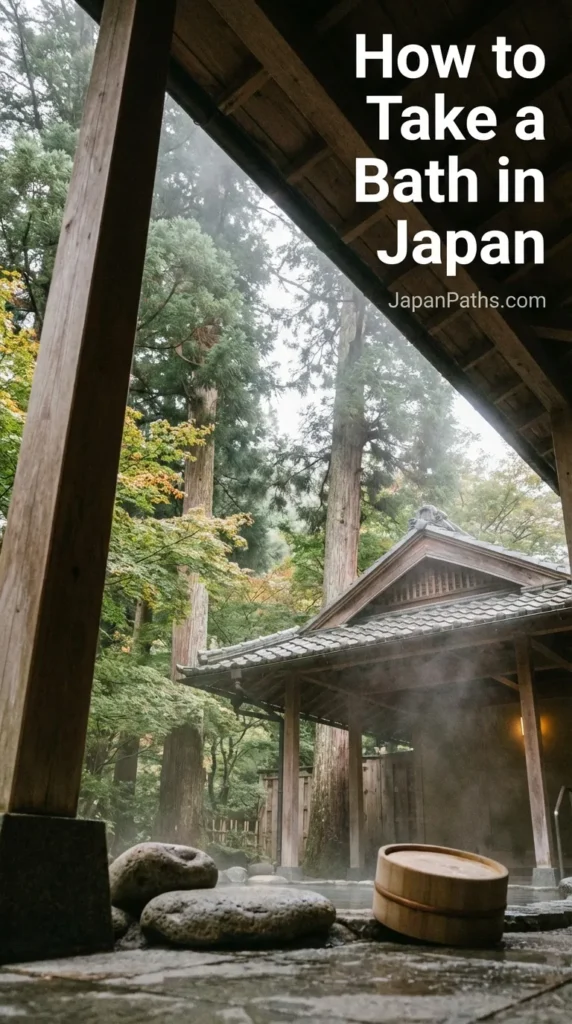
Step 2: The Changing Room (Overcoming the Nudity Hurdle)
This is the moment of truth. You must remove everything. Underwear, jewelry, watches. Place your clothes in the basket or locker.
Take only your small face towel with you. Leave the big towel in the locker.
I know this feels scary for the first time. But I promise you: nobody is looking at you. Japanese people are taught to avert their gaze. We are there to relax, not to judge bodies. Walk with confidence (or fake it!). You can use your small towel to cover your front as you walk to the washing area.
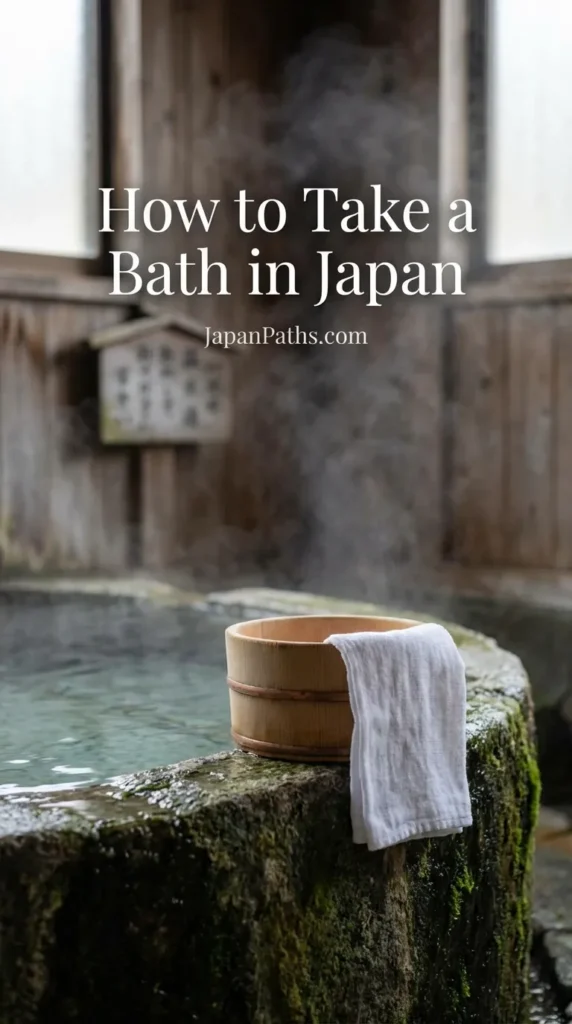
Step 3: The Washing Station (The ‘Sit Down’ Rule)
Crucial Rule: You never, ever enter the bathwater without washing first.
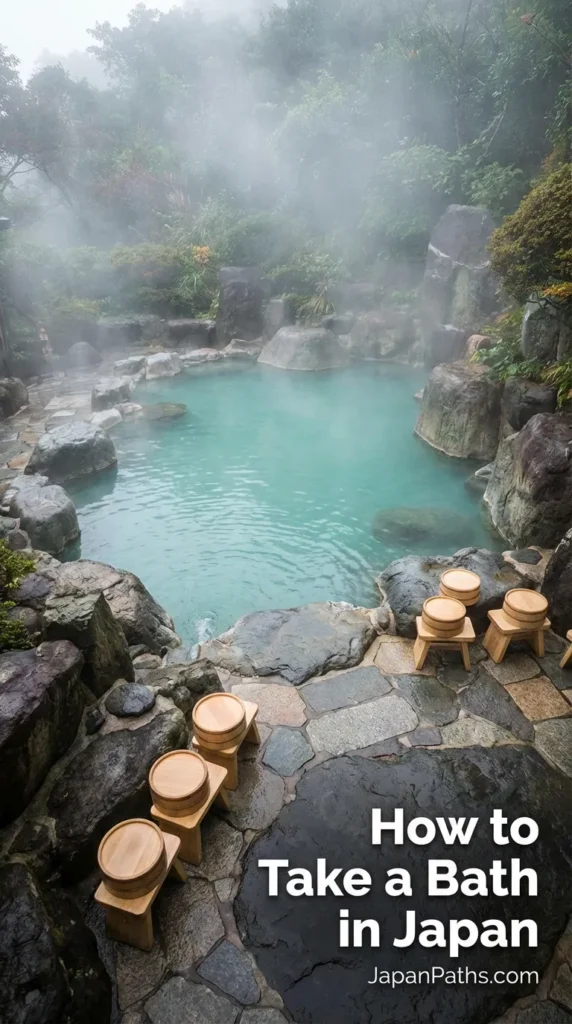
Walk to the rows of faucets and stools. Sit down on the stool. Do not shower standing up—splashing water on your neighbors is considered very rude.
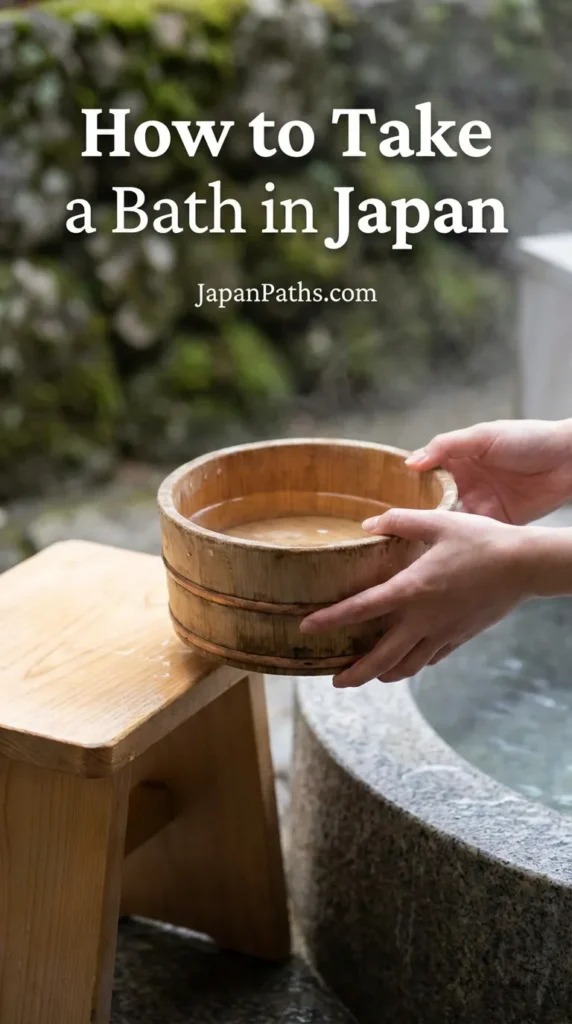
Rinse the stool with a bowl of water before you sit. Scrub your entire body with soap. Shampoo your hair. Rinse thoroughly. No soap suds should ever enter the communal bath. Once you are done, rinse the stool and the area around you for the next person.
Step 4: Kakeyu (The Crucial Pre-Soak Ritual)
You are clean, but you aren’t ready to jump in yet. The water in Onsens can be very hot (often 40°C to 42°C).
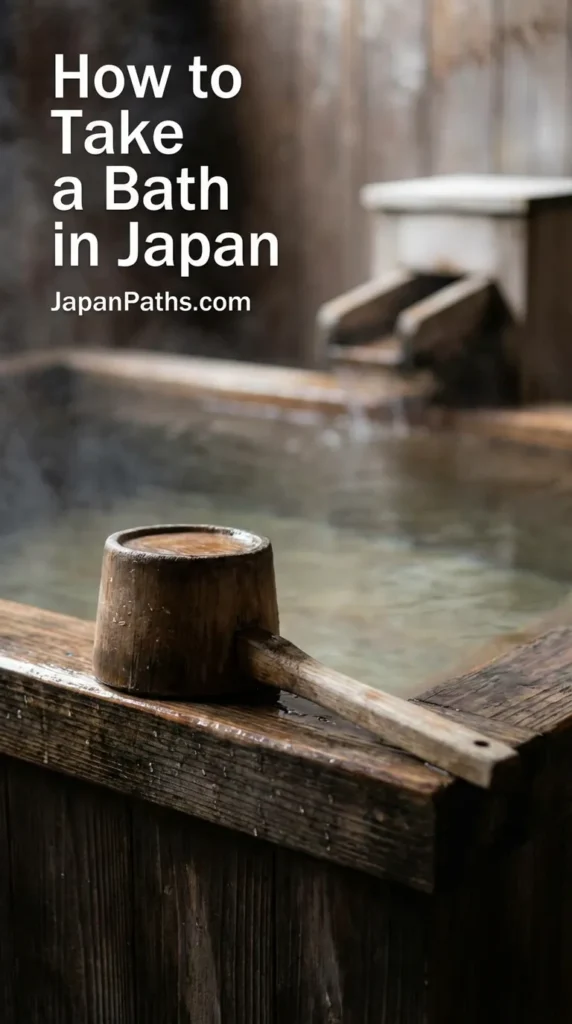
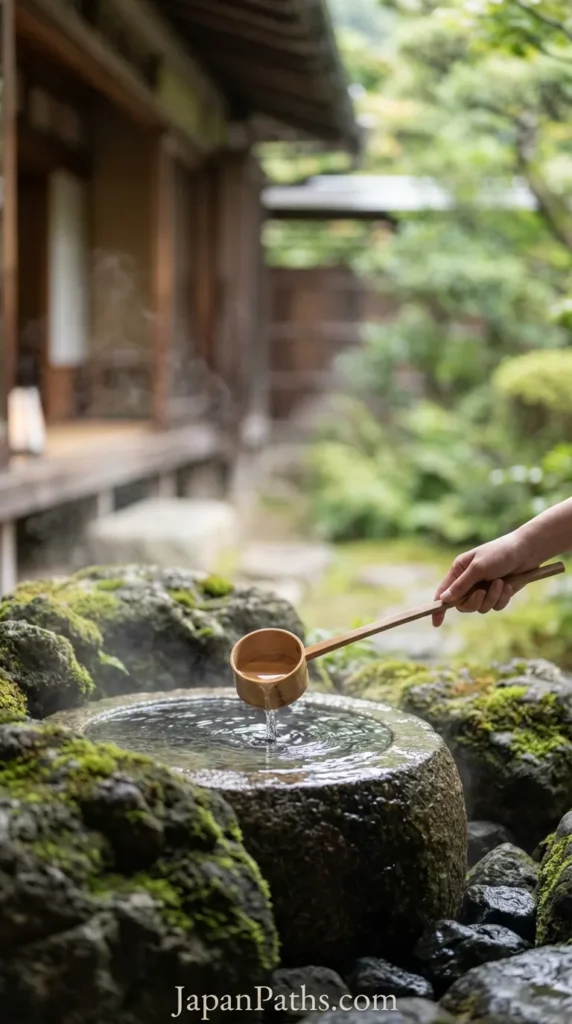
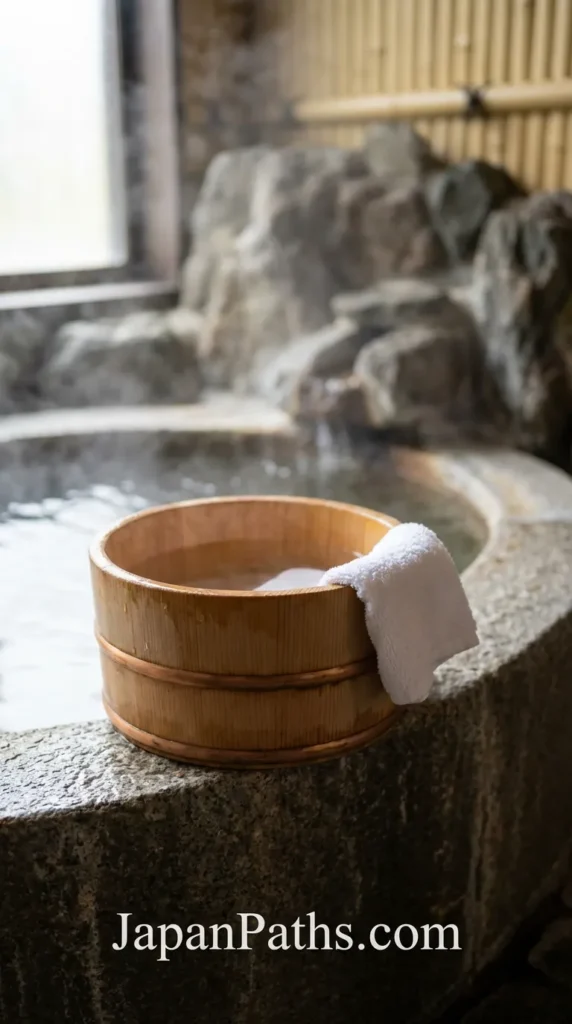
Perform Kakeyu. Take a bucket, scoop water from the bath, and splash it on your feet, then your legs, then your shoulders. This signals to your body that the heat is coming and prevents blood pressure shock. It’s also a final rinse to show respect to other bathers.
Step 5: The Soak (Towel Placement & Silence)
Now, step in slowly. Glide into the water without splashing.
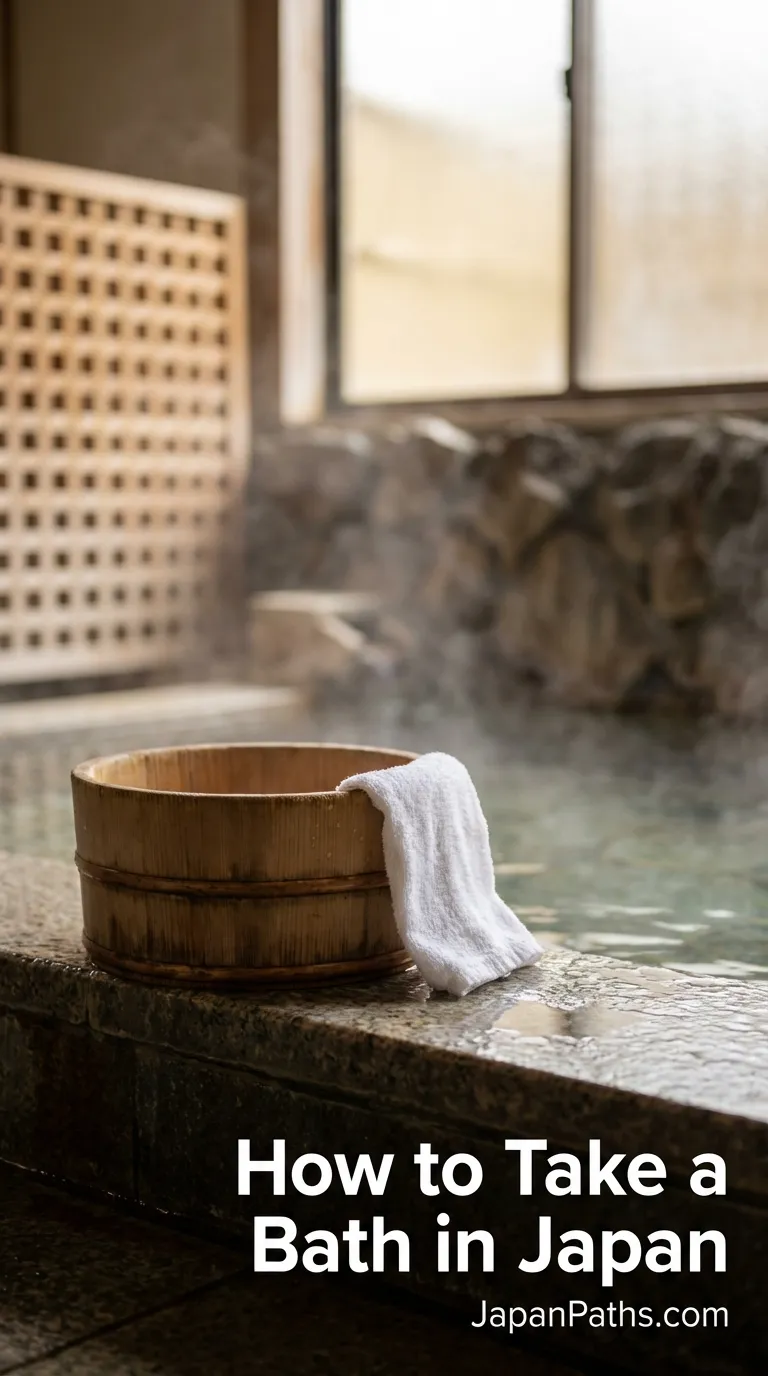
The Towel Rule: Your small modesty towel must not touch the water. It is considered “dirty” because you carry it around. You have two options:
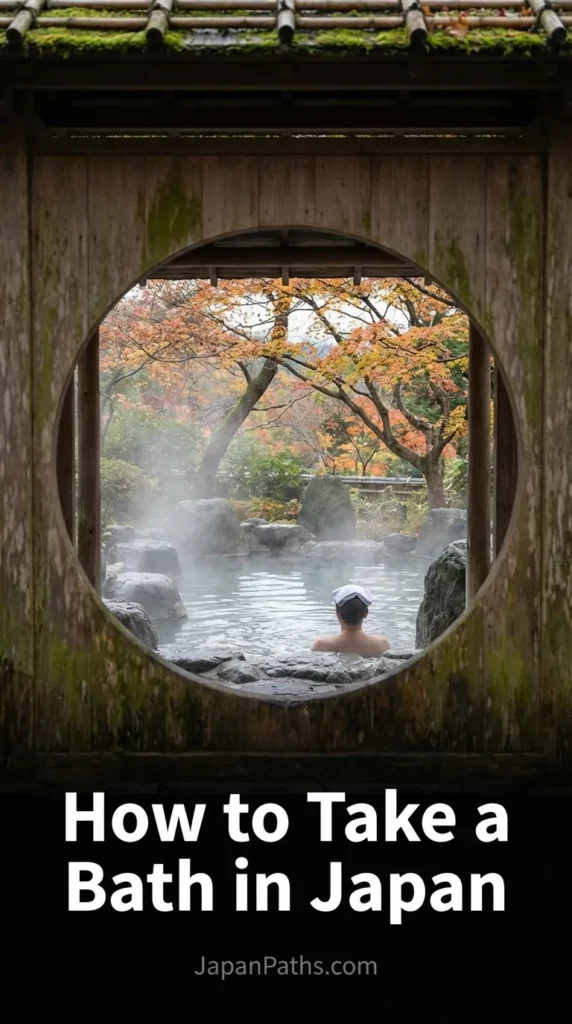
- Fold it and place it on your head (the classic “Onsen look”).
- Place it on a rock or the side of the bath (make sure it doesn’t fall in).
Kaori’s Tip: If you feel dizzy, soak your towel in cold water (from the tap) before putting it on your head. It keeps your head cool while your body stays hot.
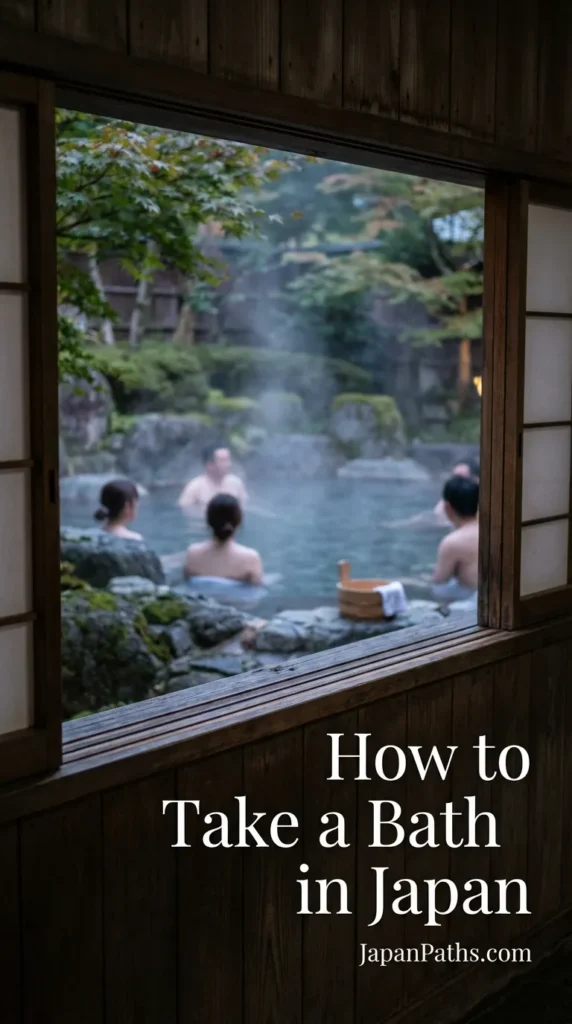
Once you are in, just breathe. Close your eyes. Listen to the water. If you are with friends, chat quietly. Loud laughter or shouting breaks the wa (harmony) of the bath.
Step 6: The Exit (The ‘Wipe Before You Walk’ Rule)
This is the mistake I see tourists make most often.
When you are finished soaking, do not walk back into the changing room dripping wet.
Stand up, step out of the bath, and use your small damp towel to wipe your body down as much as possible while you are still in the tiled bathing area. Wring out the towel and wipe again. Only when you are mostly drip-free should you step onto the mats of the changing room.
Why? Because wet floors in the changing room are slippery and gross for people wearing socks or walking barefoot. It is basic etiquette.
Step 7: The Post-Bath Ritual (Milk & Relaxation)
You are dressed, dried, and glowing. Now for the best part.
In the lobby, look for a vending machine selling glass bottles of milk. This is a Showa-era tradition. You will usually see:
- White Milk: Pure and creamy.
- Coffee Milk: Sweet and nostalgic.
- Fruit Milk: A yellowish, sweet fruit blend.
Place your hand on your hip (traditional stance!), tilt your head back, and drink it in one go. It is the most refreshing feeling in the world.
The Tattoo Dilemma: A 2026 Reality Check
I get asked this question more than any other: “Kaori, I have a tattoo. Can I enter?”
The short answer: It is getting better, but it is still complicated. Historically, tattoos (Irezumi) were associated with the Yakuza (mafia). While most Japanese know tourists aren’t gangsters, the “No Tattoo” rule remains in many old-school places to avoid conflict.
The Three Categories of Onsen Policy
- Strictly No Tattoos: Many large “Super Sentos” and traditional public Onsens still have a zero-tolerance policy. If you are seen, you will be asked to leave.
- Cover-Up Allowed: Some places allow entry if you cover the tattoo with a skin-colored adhesive patch (sold at drugstores or the front desk). This usually applies if your tattoo is small (palm-sized).
- Tattoo Friendly: These are becoming more common, especially in tourist areas like Kinosaki Onsen and Beppu.
Kaori’s Solutions for Inked Travelers
If you have large tattoos (sleeves or back pieces), I highly recommend booking a Private Onsen (Kashikiri). This is actually a more luxurious experience anyway!
You can rent a private bath for 45 minutes, or stay in a room with a bath attached. I have curated a list of the best Ryokans with private onsens here—many have stunning views of Mt. Fuji.
Also, if you want a town where you can roam freely, you must read my guide to Kinosaki Onsen. It is one of the most tattoo-friendly towns in Japan, where 7 public baths welcome everyone regardless of ink.
Onsen vs. Sento: What’s the Difference?
You will hear both terms. Here is how to distinguish them:
Onsen (Hot Spring):
The water comes from the earth. It contains natural minerals. These are usually destinations in themselves (like Hakone, Beppu, or Kusatsu). They focus on healing and nature.
Sento (Public Bath):
The water is heated tap water. These are community hubs in cities. They often have huge murals of Mt. Fuji painted on the wall. They are cheaper (around 500 yen) and are for daily hygiene.
Super Sento:
These are like bath theme parks! They have saunas, multiple jet baths, restaurants, and nap rooms. They are modern, clean, and a great way to spend a rainy afternoon in Tokyo.
Kaori’s Top Onsen Recommendations for Beginners
If you are nervous, start with these user-friendly spots.
1. The Easy Day Trip: Hakone Yuryo (Hakone)
This is a beautiful day-spa facility. It is private, wooded, and very accustomed to foreign guests. They have lovely private rooms you can rent by the hour.
- Rating: 9/10
- Vibe: Forest Retreat
- Access: Shuttle bus from Hakone-Yumoto Station.
2. The Theme Park: Spa LaQua (Tokyo)
Located right in the center of Tokyo (Tokyo Dome City). It uses natural onsen water pumped from deep underground. It is modern, clean, and requires no travel time.
- Rating: 8.5/10
- Vibe: Urban Luxury
- Location: Bunkyo City, Tokyo
For a full list of how to integrate these into your trip, check out my comprehensive Japan itineraries which balance sightseeing with plenty of relaxation time.
12 Common Questions (FAQ) – Kaori Answers
1. Can I wear a swimsuit if I’m really shy?
Generally, no. In a traditional Onsen, swimsuits are considered dirty from the outside world. However, some mixed-gender places (like Yunessun in Hakone) are “swimsuit zones.” Always check the website. If it says “Onsen,” assume nudity. If it says “Pool” or “Aqua Park,” swimsuits are likely okay.
2. What if I have my period?
It is generally considered poor etiquette to use the communal bath during your period, largely due to concerns about hygiene and blood contaminating the water. I recommend using the shower in your room or booking a private family bath (Kashikiri) if you are comfortable.
3. Can I bring my baby or young child?
Yes, usually! Japanese Onsen are family places. However, if your baby is still in diapers, they may not be allowed in the main tub. Some places provide baby baths you can fill with water next to the main tub. Always watch your children to ensure they don’t run or swim.
4. Why are the towels so small?
The small towel is a multi-tool. It’s a washcloth for scrubbing, a modesty shield for walking, and a cooling compress for your head. A large towel would be too heavy to manage and would soak up too much water.
5. Is the water really that hot?
Yes. It is often 40°C-42°C (104°F-108°F). If you aren’t used to it, you might feel dizzy. Start with your legs only. Soak for 5 minutes, then sit on the edge to cool down. Do not force yourself to stay in.
6. Are men and women always separated?
In 95% of cases, yes. Mixed bathing (Konyoku) is a relic of the past and is mostly found in very rural, traditional outdoor springs. In cities and Ryokans, they are strictly separated.
7. Can I drink alcohol in the bath?
No! This is dangerous. The hot water lowers your blood pressure, and alcohol dehydrates you. You could faint or drown. Save the sake for your kaiseki dinner afterwards. Read my guide on the best food experiences to plan your post-bath meal.
8. Do I need to tip the staff?
No. Japan is a no-tipping culture. The service charge is included. A simple “Arigato gozaimasu” is the best thanks.
9. What if I see someone staring at me?
As a foreigner, you might get a curious glance, but it is rarely malicious. In rural areas, locals might just be surprised to see you. Smile, say “Konnichiwa,” and enjoy your bath. They will likely smile back.
10. Is it okay to shave in the Onsen?
At the washing station, yes. Disposable razors are often provided. But please rinse the area thoroughly afterwards. Never shave inside the bathtub itself.
11. Can I go to an Onsen if I am pregnant?
Historically, it was discouraged, but modern Japanese doctors generally say it is fine if the pregnancy is stable and you don’t overheat. However, the floors are slippery, so be extra careful. Avoid the very hot tubs.
12. What is “Yu-atari”?
It means “hot water intoxication” or dizziness from bathing too long. If you feel nauseous or lightheaded after the bath, lie down, drink water, and cool your forehead. It happens to the best of us!
Conclusion: Embracing the Vulnerability
I know this seems like a lot of rules. “Don’t splash,” “don’t dip the towel,” “wash the stool.”
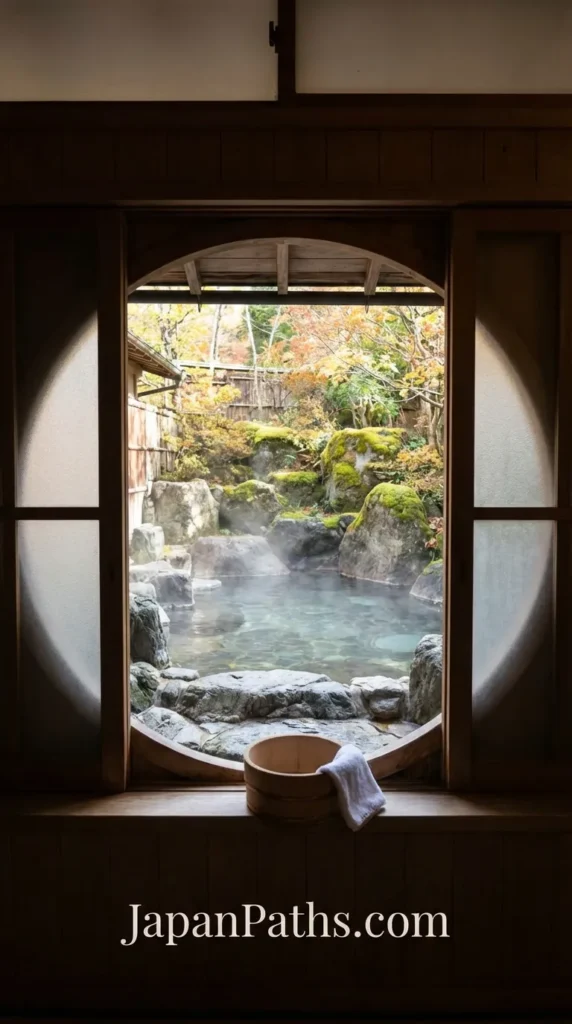
But please don’t let the rules scare you away. These manners exist not to restrict you, but to create a space of perfect harmony for everyone. Once you slide into that hot water and feel the tension melt from your shoulders, you will understand.
The Onsen is one of the few places in the world where you can simply be. No phone, no clothes, no status. Just you and the water.
If you are planning your trip, don’t forget to look at my destinations guide to find the best Onsen towns for your itinerary.
Relax, breathe, and enjoy the soak.
Arigato for reading,
Kaori