
Konnichiwa! I’m Kaori. Born in the quiet, temple-filled streets of Kyoto and now navigating the neon rush of Tokyo, I’ve spent my life bridging these two worlds. I started JapanPaths.com to help travelers like you look past the postcards and find the real, breathing Japan.
Japan is a country of unwritten rules. We call it Kuuki wo yomu—”reading the air.” For a first-time visitor, this air can feel thick with invisible tripwires. I see it every day: the stressed family dragging massive suitcases through a rush-hour station, the confused traveler trying to tip a polite waiter, or the heartbroken fan turned away from Ghibli Park because they didn’t book three months ago.
I don’t want that to be you. In 2026, travel here has changed. Prices have shifted, crowds have returned, and new rules (especially in my hometown of Kyoto) are strictly enforced.
Whether you are planning a first-time itinerary or a return trip, this guide is my personal letter to you. Here are the 12 mistakes I see most often, and exactly how to fix them.
1. Blindly Buying the JR Pass (The “It’s Too Expensive” Trap)
For decades, the Japan Rail Pass was the golden ticket. You bought it, you saved money. Simple.
However, since the massive price hike in late 2023, the math has completely changed. In 2026, a 7-day Ordinary Pass costs nearly ¥50,000. I still see tourists buying it for a simple round trip between Tokyo and Kyoto. Please stop doing this!
A round-trip Shinkansen ticket from Tokyo to Kyoto costs about ¥28,000. If you buy the ¥50,000 pass, you are literally throwing away ¥22,000 (about $150 USD) per person. That’s enough for a high-end Kaiseki dinner!
🌸 Kaori’s Local Fix
Only buy the pass if you are doing a “Grand Tour”—for example, Tokyo → Kyoto → Hiroshima → Fukuoka → Tokyo within 7 days. For anything less, buy point-to-point tickets or look into regional passes like the JR West Kansai Wide Area Pass. I’ve written a detailed breakdown to help you do the math: read my guide on whether the JR Pass is still worth it in 2026.
2. The “Luggage Drag” (Hauling Suitcases on Trains)
There is a specific look of panic I see on the faces of tourists at Shinjuku Station. They are clutching two massive suitcases, sweating, blocking the flow of 3,000 commuters, and trying to navigate a staircase because they can’t find the elevator.
In Japan, we rarely carry big luggage on trains. We use Takkyubin (luggage forwarding services). Companies like Yamato Transport (look for the black cat logo) will ship your bag from your hotel in Tokyo to your hotel in Kyoto for about ¥2,500 ($17). It arrives the next day.
The Mistake: Bringing large luggage onto the Shinkansen without a reservation. In 2026, you must reserve the “Baggage 160” seats for oversized luggage on the Tokaido Shinkansen. If you don’t, you’ll be fined and might have to move to a different car.
🌸 Kaori’s Local Fix
Pack a small overnight bag. Send your big suitcase to your next destination the morning you check out. Travel hands-free. Trust me, walking through the bamboo groves of Arashiyama is much nicer without a 20kg anchor attached to your arm.
3. Being a “Maiko Paparazzi” in Kyoto (Gion Bans)
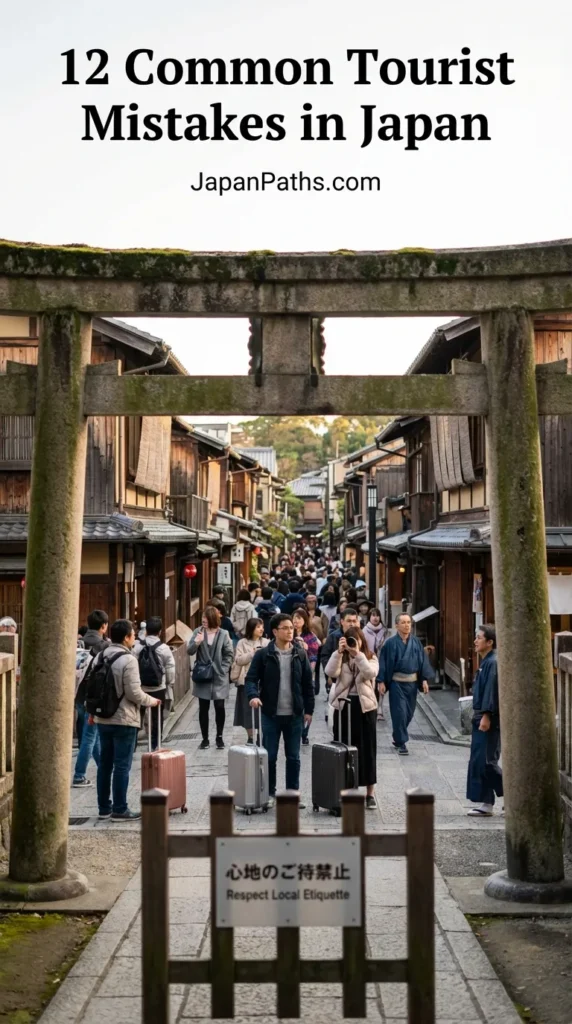
This one hurts my heart. Growing up in Kyoto, Gion was a place of mystery and respect. Recently, it became a zoo. Tourists were chasing Geiko and Maiko (apprentice geisha), pulling their kimonos, and blocking their way to work.
As of 2024/2025, the local council has banned tourists from entering many private alleys in Gion. You will see signs that say “No Entry” or “Private Road.” Do not ignore these. The fine is ¥10,000, but the shame is worse.
The Mistake: Treating Kyoto like a theme park and its residents like actors. Real people live here.
🌸 Kaori’s Local Fix
Stick to Hanamikoji Street (the main public street). If you want to see a Maiko, book an authentic tea ceremony or a dinner show. Don’t hunt them in the streets. It’s not just rude; it’s now illegal in specific zones.
4. Tabearuki (Walking and Eating)
In the West, grabbing a sandwich and eating it while walking to your next meeting is efficient. In Japan, it is considered sloppy. The term is Tabearuki.
While younger generations are more relaxed about this, it is still frowned upon to walk down a busy street while munching on a burger. It risks spilling food on others and disrespects the food itself.
The Nuance: “But Kaori, what about street food markets?” Yes! At places like Tsukiji Outer Market or Nishiki Market, you buy the food and eat it standing in front of the stall. You do not wander away with it.
5. The “Loud American” on Trains
I apologize for the stereotype, but it is often true! Japanese trains are libraries on wheels. People are sleeping, reading, or quietly scrolling.
The Mistake: Having a loud conversation, laughing boisterously, or—worst of all—taking a phone call. If your phone rings, you should decline it immediately. If it’s an emergency, you go to the deck area between cars (on the Shinkansen).
🌸 Kaori’s Local Fix
Use your “indoor voice” everywhere, but especially on transit. If you are traveling with a group, whisper. If you are solo, enjoy the silence. It’s one of the few times in Tokyo you can find true peace.
6. Tipping (Just Don’t Do It)
I know you want to be nice. The service was amazing! You want to leave ¥1,000 on the table.
Please don’t. In Japan, good service is the standard, not an optional extra rewarded by money. Tipping causes confusion. The staff will likely run after you, thinking you forgot your change. It can even be seen as condescending, implying their employer doesn’t pay them enough.
The Exception: A high-end Ryokan (traditional inn). You can leave a small envelope with money for the Nakai-san (room attendant) at the start of your stay, but this is old-school etiquette and not expected of tourists.
7. Shoe Etiquette Chaos
You know you need to take your shoes off at temples and ryokans. But there are layers to this rule that trip people up.
- The Tatami Rule: Never, ever step on a Tatami mat with slippers. Only socks or bare feet (though socks are preferred).
- The Toilet Slipper Trap: Inside a home or ryokan, there are special slippers inside the toilet room. You put them on to do your business. You must take them off before you step back into the hallway. Walking around a restaurant in toilet slippers is the ultimate embarrassment!
- Dressing Rooms: Even in clothing stores (like Uniqlo), you take your shoes off before stepping into the fitting room.
8. Underestimating the “Cash is King” Rule
Yes, Japan has modernized. You can use Apple Pay at 7-Eleven and Visa at Starbucks. But do not get comfortable.
The Mistake: Going to a ramen shop, a temple ticket booth, or a rural bus station with only your phone. Many ticket machines for ramen shops only take cash. Old kissaten (coffee shops) often refuse cards. Taxis in the countryside might not have card readers.
🌸 Kaori’s Local Fix
Always carry at least ¥10,000 to ¥20,000 in cash. Keep a coin purse for the ¥100 and ¥500 coins—you will need them for vending machines and lockers.
9. The Trash Can Hunt (and Littering)
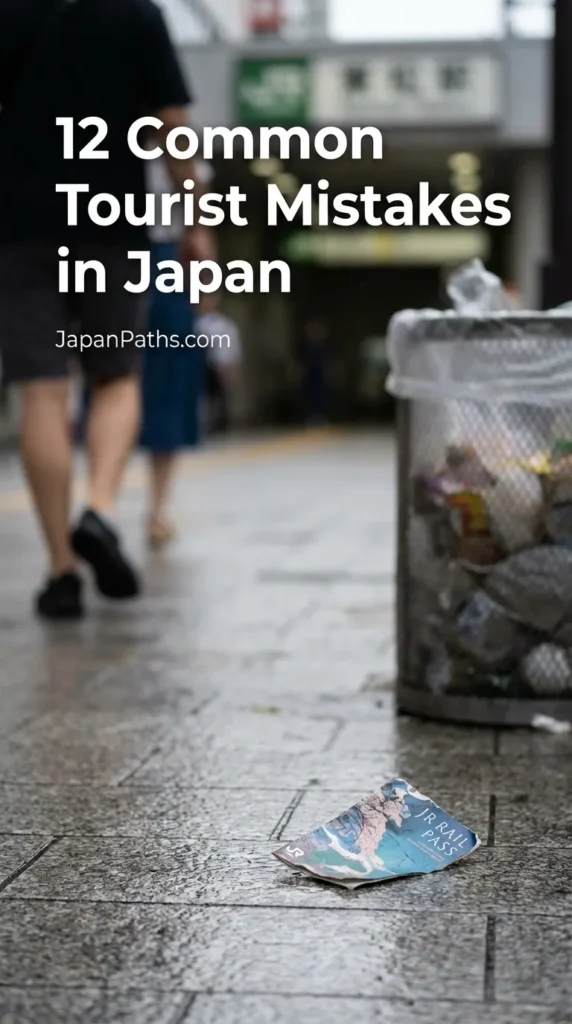
You will buy a matcha latte, finish it, and then walk for 20 minutes looking for a trash can. There aren’t any. Following the 1995 sarin gas attacks, many public bins were removed.
The Mistake: leaving your empty cup on a random ledge or stuffing it into a vending machine recycling bin (which is only for bottles and cans). This is incredibly rude.
🌸 Kaori’s Local Fix
Carry a small plastic bag in your tote. This is your personal trash can. Take your trash back to your hotel to dispose of it properly. It’s part of the travel experience here!
10. Escalator Confusion (Left vs. Right)
This is a fun one. In Tokyo, we stand on the left and walk on the right. In Osaka, they stand on the right and walk on the left. In Kyoto? It’s a mix, but usually follows the Osaka style.
The Mistake: Standing in the middle or standing on the “walking” side during rush hour. You will feel the burning gaze of a hundred salarymen behind you.
11. The “Wing It” Strategy for Major Attractions
“I’ll just buy tickets to Ghibli Park when I get there.” No, you won’t. You absolutely won’t.
Popular spots in Japan sell out months in advance.
- Ghibli Park/Museum: 2-3 months in advance.
- Shibuya Sky (Sunset slot): 4 weeks in advance.
- TeamLab Planets: 1-2 months in advance.
- Universal Studios Japan Express Pass: 2 months in advance.
- High-end Omakase: Sometimes 6 months in advance!
If you don’t book, you don’t go. It’s that simple.
12. Ignoring Seasonality & Weather
I love Japan in all seasons, but they are extreme.
- Summer (July-August): It is not just hot; it is a sauna. The humidity is 90%. You will sweat through your shirt in 5 minutes. If you aren’t prepared, you will be miserable.
- Rainy Season (June): It rains every day.
- Winter (January-February): Tokyo is dry and sunny, but crisp. Kyoto is bone-chillingly cold because of the wooden buildings.
The Mistake: Packing jeans for August (too heavy, won’t dry) or forgetting thermal layers for a winter temple visit.
Kaori’s Etiquette Corner: The Magic of “Sumimasen”
If you learn one word, make it Sumimasen (Sue-me-mah-sen). It means “Excuse me,” “Sorry,” and “Thank you” all in one.
- Bump into someone? Sumimasen.
- Calling a waiter? Sumimasen!
- Someone holds the door? Sumimasen.
It is the WD-40 of Japanese social interaction. Use it liberally.
Kaori’s Packing List: Aesthetic & Practical
What you wear matters, not just for style, but for comfort. Here is what I pack for a weekend trip:
Spring/Autumn (The Golden Seasons)
- Trench Coat: Classic, chic, and wind-resistant.
- Slip-on Shoes: Crucial for temples. Do not bring boots with 20 laces.
- Layers: A light cardigan. Trains are hot, streets are cool.
Summer (The Survival Season)
- AIRism (Uniqlo): I live in these moisture-wicking undershirts.
- Handkerchief: Every local carries a small towel cloth to wipe sweat.
- Parasol: Not just for rain. The UV is strong.
Winter (The Cozy Season)
- HeatTech: Essential.
- Warm Socks: Remember, you take your shoes off in temples, and the wood floors are freezing.
- Good Moisturizer: Tokyo winters are incredibly dry.
Essential Logistics: Don’t Go Offline
Google Maps is great, but it’s not enough. You need specific apps to navigate the complex train system and translation barriers. I have curated a list of the absolute must-haves on your phone. Before you board your flight, please download these 7 essential apps for Japan travel.
FAQ: Kaori Answers Your Questions
1. Is Japan strictly cash-only in 2026?
No, it has improved massively. Most convenience stores, department stores, and hotels take cards. However, you still need cash for: charging your IC card at older machines, small shrines/temples (entry fees and charms), rural buses, and older Ramen shops. Don’t rely 100% on your phone.
2. Can I use my JR Pass on the Nozomi Shinkansen?
Yes, but with a catch. As of late 2023, you can ride the Nozomi (the fastest train) with a JR Pass only if you pay a supplemental fee per ride. Without the fee, you are restricted to the Hikari or Kodama trains, which are slower and less frequent. This is another reason why the pass is often not worth it.
3. What should I do with my trash if I can’t find a bin?
You must carry it with you. Do not leave it on the street. I carry a small ziplock bag in my purse specifically for trash. You can usually find bins at convenience stores (if you bought something there) or train station platforms.
4. Are tattoos still a problem in Onsens?
Yes, largely. While some tourist-friendly spots now accept them, most traditional Onsens and Sentos (public baths) still ban guests with visible tattoos. If your tattoo is small, cover it with a waterproof bandage. If it’s large, look for “Tattoo Friendly” onsens or book a Ryokan with a private bath (Kashikiri-buro).
5. Is it safe to walk alone at night?
Japan is one of the safest countries in the world. As a woman, I feel comfortable walking alone in Tokyo at 2 AM. However, exercise standard caution in nightlife districts like Kabukicho (Shinjuku) or Roppongi, where touts can be aggressive.
6. Do I need to speak Japanese?
You can survive with English, especially in Tokyo and Kyoto. Signs are bilingual. However, knowing basic phrases like Arigato Gozaimasu (Thank you) and Sumimasen (Excuse me) goes a long way. Translation apps like DeepL or Google Translate are lifesavers for reading menus.
7. Can I request a vegetarian meal easily?
It is getting easier, but still tricky. Traditional Dashi (soup stock) usually contains fish (bonito), even in vegetable dishes. If you are strict vegetarian or vegan, use apps like HappyCow to find specific restaurants, or look for “Shojin Ryori” (Buddhist vegetarian cuisine), which is delicious and completely vegan.
8. How do I pay for the bus?
In Tokyo, you enter at the front and pay a flat fare (tap your IC card). In Kyoto, you enter at the back, take a ticket (if paying cash), and pay when you exit at the front. If using an IC card in Kyoto, tap when you enter and tap when you exit.
9. Is tap water drinkable?
Yes! Japan’s tap water is clean, safe, and tastes good. Bring a reusable water bottle to save money and reduce plastic waste. There are water fountains in many parks and stations (look for the app “MyMizu” to find refill spots).
10. What if I’m late for my Shinkansen reservation?
Don’t panic. If you miss your reserved train, your ticket is usually still valid for the “Non-Reserved” cars on any subsequent train on the same day. You just lose your guaranteed seat.
11. Should I rent a pocket WiFi or get an eSIM?
In 2026, eSIMs are the superior choice if your phone is unlocked. They are cheaper and you don’t have to carry (or charge) an extra device. Pocket WiFi is only better if you are traveling as a large group and want to share one connection.
12. How much should I budget for food?
You can eat incredibly well on a budget.
Breakfast (Konbini): ¥500 – ¥800
Lunch (Set meal): ¥1,000 – ¥1,500
Dinner (Izakaya): ¥3,000 – ¥5,000
Of course, sky is the limit for high-end sushi, but delicious food is available at every price point.
Japan is a country that rewards preparation. By avoiding these common mistakes, you aren’t just saving money or time—you are showing respect to the culture. And in return, Japan will open up to you in ways you can’t imagine.
If you are feeling overwhelmed, start simple. Browse our other guides, take a deep breath, and remember: even if you make a mistake, a sincere “Sumimasen” and a smile will fix almost anything.
Safe travels, and maybe I’ll pass you on the streets of Tokyo!
— Kaori