
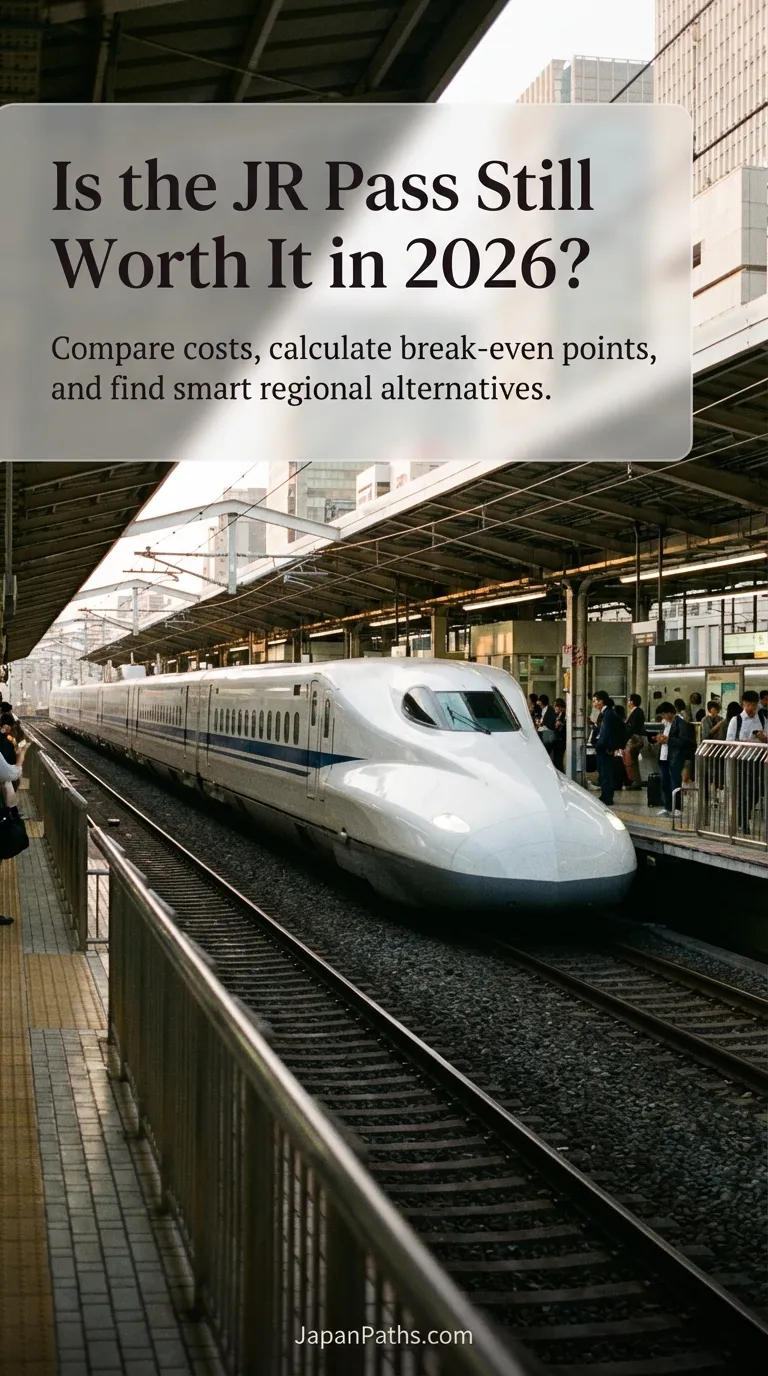

The Japan Rail Pass used to be an automatic purchase for most visitors to Japan. After the significant price increases in late 2023, travelers now face a much tougher decision.
The 7-day pass jumped to 50,000 yen. The 14-day pass hit 80,000 yen, and the 21-day pass soared to 100,000 yen.
The JR Pass is still worth it in 2026 if you plan multiple long-distance Shinkansen trips within a short time frame, but it no longer saves money for every traveler. I’ve watched the value equation shift dramatically after the price hikes.
What once made sense for nearly any multi-city trip now requires careful route planning and honest math. I’ll show you exactly when the pass pays off and when individual tickets or regional passes work better.
You’ll learn how to calculate break-even points for your specific itinerary. I’ll also highlight what the pass actually covers and some smarter alternatives that a lot of people miss.
Key Takeaways
- The JR Pass costs 50,000 yen for 7 days, 80,000 yen for 14 days, and 100,000 yen for 21 days after the 2023 price increase.
- The pass saves money on multi-city itineraries with several long-distance Shinkansen rides, but often costs more than individual tickets for shorter trips.
- Regional passes and individual ticket purchases frequently offer better value for travelers focusing on specific areas or moving at a slower pace.
JR Pass in 2026: What Has Changed and Who Should Consider It
The Japan Rail Pass landscape shifted dramatically in October 2023 when JR Group raised prices by roughly 70%. The 7-day ordinary pass now costs 50,000 yen.
Eligibility rules have expanded to include some Japanese nationals living abroad. The price increase fundamentally changed how travelers need to think about the JR Pass.
Before October 2023, the 7-day ordinary pass cost 29,650 yen. It now costs 50,000 yen.
The 14-day pass jumped from 47,250 yen to 80,000 yen. The 21-day pass increased from 60,450 yen to 100,000 yen.
Green Car passes also saw similar increases. The 7-day Green Car pass went from 39,600 yen to 70,000 yen.
The 14-day version now costs 110,000 yen. The 21-day version is 140,000 yen.
These higher prices mean a simple Tokyo to Kyoto to Osaka trip no longer justifies buying the pass. I now need to include additional destinations like Hiroshima or multiple day trips to break even on the 50,000 yen cost.

Who Can Buy the Pass and Eligibility
Foreign tourists visiting Japan on a temporary visitor visa can purchase the national JR Pass. This includes most tourists entering Japan for sightseeing purposes.
Japanese nationals living permanently abroad can also buy the pass if they meet specific requirements. You need proof of residence outside Japan for at least 10 consecutive years.
You must also show your Japanese passport with documentation proving your overseas residence. Japanese nationals with non-Japanese spouses living abroad may qualify under certain conditions.
You need to provide your marriage certificate and proof of overseas residence. You can now purchase the pass directly in Japan at JR offices in major stations.
Previously, you had to buy an exchange order before arriving. This change makes last-minute purchases easier if you decide the pass makes financial sense after arriving.
Types of Passes: Ordinary, Green Car, Regional Options
The Ordinary Pass gives me access to regular reserved and non-reserved seats on JR trains. This includes most shinkansen bullet trains operated by JR Central, JR East, JR West, and other JR companies.
The Nozomi and Mizuho fastest shinkansen services are not included. The Green Car pass provides access to premium seating with more legroom and quieter cabins.
Green Car seats are similar to business class on planes. Most travelers don’t need this upgrade unless comfort is a priority.
Regional JR passes often provide better value than the national pass for focused trips. JR East offers passes covering Tokyo and northeastern regions.
JR West has multiple options for Kansai and western Japan travel. JR Kyushu, JR Hokkaido, and JR Shikoku each offer regional passes for their areas.
The JR West Kansai Wide Area Pass costs just 12,000 yen for five days and covers Osaka, Kyoto, Nara, Kobe, and Himeji. The JR West Sanyo-San’in Pass at 23,000 yen for seven days covers everything from Kansai to Fukuoka including Hiroshima.
I calculate my specific routes before deciding between a national JR Pass or a regional JR pass. The regional pass alternatives often save 10,000 to 20,000 yen compared to the full national pass.
Coverage and Limitations: Where Can You Use the JR Pass?
The JR Pass covers most JR-operated trains across Japan, including many Shinkansen lines and local routes in major cities. However, it doesn’t work on private railways, most subway systems, or the fastest bullet trains without paying extra fees.
Shinkansen, Limited Express, and Covered Lines
The JR Pass works on most Shinkansen bullet trains, including the Hikari and Sakura services that connect major cities. These trains are nearly as fast as the premium options and get you between Tokyo, Kyoto, Osaka, Hiroshima, and other cities efficiently.
You can also use the pass on all JR lines throughout the country. This includes limited express trains to destinations like Kanazawa, Nagano, Takayama, and Matsumoto.
In cities, the pass covers useful routes like the Yamanote Line in Tokyo and the Osaka Loop Line. The pass works on airport connections too.
I could use it on the Narita Express from Narita Airport and the Tokyo Monorail from Haneda Airport. The JR ferry to Miyajima from Hiroshima is also included.
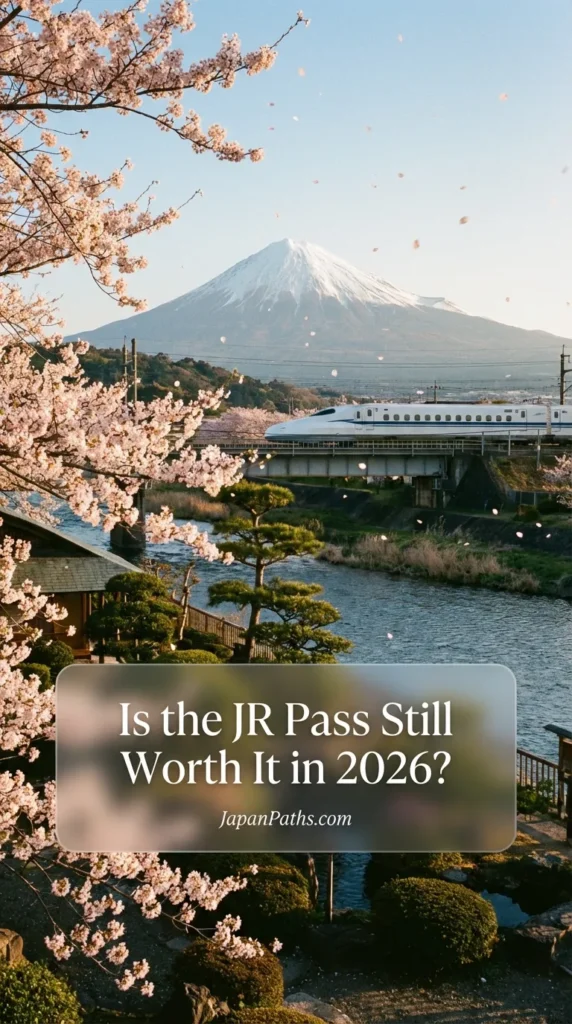
Important Exclusions: Nozomi, Mizuho, and Private Railways
The fastest Shinkansen services, Nozomi and Mizuho, require an additional fee even with the JR Pass. These trains only save about 10 to 20 minutes compared to Hikari and Sakura trains, so paying extra rarely makes sense.
The bigger limitation is that the JR Pass does not cover non-JR trains. Private railways operate many important routes, especially for day trips.
Lines like Kintetsu, Hankyu, Keihan, Odakyu, Nankai, and Keio are completely separate systems. These private lines are essential for reaching places like Nara (Kintetsu Railway), Kobe (Hankyu Railway), and Hakone (Odakyu).
You’ll need to buy separate tickets or use an IC card for these trips.
Urban Transport and Local Connections
The JR Pass doesn’t work on subway systems in major cities. Tokyo Metro and Osaka Metro require separate payment.
This catches many travelers off guard because subways are often the most convenient way to get around cities. For daily urban travel, I recommend getting a Suica or Pasmo card.
These rechargeable IC cards work on subways, private railways, and even some buses and vending machines. They’re separate from the JR Pass but essential for filling in the gaps.
If you’re spending significant time in one region, regional JR passes like the JR Kyushu Pass, Hokuriku Arch Pass, or JR Hokkaido Pass often provide better value. These cover the same JR lines within their areas but cost much less than the national pass.
JR Pass Price Breakdown and How to Calculate Value
The JR Pass underwent a major price increase in October 2023, jumping nearly 70% across all pass types. Understanding the current costs and calculating whether the pass saves you money requires comparing your specific travel plans against individual ticket prices.
Current Pricing: 7, 14, and 21-Day Passes
The current JR Pass prices for 2026 are significantly higher than pre-2023 rates. A 7-day ordinary pass costs ¥50,000, the 14-day pass costs ¥80,000, and the 21-day pass costs ¥100,000.
Before October 2023, these same passes cost ¥29,650, ¥47,250, and ¥60,450 respectively. The 7-day pass alone increased by ¥20,350, which equals about 1.5 one-way shinkansen trips between Tokyo and Kyoto.
Green Car (first class) passes cost more: ¥70,000 for 7 days, ¥110,000 for 14 days, and ¥140,000 for 21 days. Children ages 6-11 receive passes at half the adult price.
Comparison: Point-to-Point Tickets vs. JR Pass
A Tokyo to Kyoto one-way shinkansen ticket costs ¥13,320 for a reserved seat. Round-trip totals ¥26,640, which means you need ¥23,360 in additional travel to justify the ¥50,000 pass cost.
The Narita Express from the airport to Tokyo costs ¥3,320 one-way. A round-trip Tokyo to Osaka journey costs ¥27,740.
Add one Narita Express trip and you’re at ¥31,060, still nearly ¥19,000 short of breaking even.
| Route | One-Way Cost | Round-Trip Cost |
|---|---|---|
| Tokyo → Kyoto | ¥13,320 | ¥26,640 |
| Tokyo → Osaka | ¥13,870 | ¥27,740 |
| Tokyo → Hiroshima | ¥18,380 | ¥36,760 |
| Osaka → Hiroshima | ¥10,580 | ¥21,160 |
| Tokyo → Kanazawa | ¥13,960 | ¥27,920 |
The classic Golden Route (Tokyo-Kyoto-Osaka-Tokyo) now costs less with individual tickets than with a 7-day pass. This represents a significant shift from when the pass was an automatic recommendation.
Popular Itineraries and Break-Even Analysis
I analyzed several common itineraries to determine when the pass makes financial sense. A multi-region trip covering Tokyo → Kanazawa → Kyoto → Hiroshima → Fukuoka → Tokyo costs ¥67,120 in individual tickets versus ¥50,000 for the pass, saving ¥17,120.
A Tokyo-Kyoto-Osaka triangle with airport transfers totals only ¥36,830 in tickets. You’d lose ¥13,170 by purchasing the pass.
Tokyo-only trips make even less sense since the pass doesn’t cover Tokyo Metro or most subway lines.
Pass wins: Multiple long-distance journeys (500+ km each), Hokkaido exploration, spontaneous itinerary changes.
Pass loses: Single-region stays, classic Golden Route, Tokyo-only visits, slow travel with minimal train use.
JR Pass Calculator Tools and Resources
Online JR Pass calculators let you plug in your routes and check costs instantly. I usually turn to Hyperdia or the Japan Guide fare calculator for the most accurate pricing on each trip.
Be sure to enter every train ride you plan, including airport transfers and any day trips from your main cities. These calculators quickly show if a 7-day, 14-day, or 21-day pass actually saves you money based on your own plans.
Hyperdia gives you exact fares and travel times for any route. Navitime does something similar and has an English interface, which is handy. Both let you filter for JR-only routes so you can see what the pass would actually cover.
If you’re buying single tickets, don’t forget to add reservation fees (usually ¥530–¥1,050 per seat). Pass holders get those for free. Sometimes, a regional pass like the JR West Kansai Wide Area Pass (¥12,000 for 5 days) gives you better value than the national pass if your trip is focused.
When the JR Pass Is Still Worth It (and When It’s Not)
The JR Pass still makes sense for travelers hitting several cities in a short span, but it’s not the obvious bargain it used to be. Whether it’s right for you really depends on your route, pace, and what you want out of your trip.
High-Value Use Cases: Long-Distance and Fast-Paced Travel
I’ve noticed the standard JR Pass pays off when you take multiple long-distance Shinkansen rides within the pass window.
The real value shows up when you move between at least three or four big cities. For instance, Tokyo to Kyoto (¥13,650), then Kyoto to Hiroshima (¥10,420), and back to Tokyo—that’s already close to the ¥50,000 cost of a 7-day pass.
The 14-day pass at ¥80,000 starts to make sense if you’re going all out, hopping around the country. If you’re planning to see Tokyo, Kyoto, Osaka, Hiroshima, Fukuoka, and Kanazawa, plus a few side trips, you’ll probably spend more than ¥80,000 on single tickets.
I think the pass is best for “hyper-explorers”—folks who want to change cities every couple of days and don’t mind spending a lot of time on trains. If you’re after a fast-paced adventure and want unlimited travel, the pass is hard to beat for flexibility.
Situations When Individual Tickets or Regional Passes Are Better
Most first-timers sticking to Tokyo-Kyoto-Osaka don’t need the full JR Pass. That classic round-trip is just about ¥29,600, way under the pass price.
Take a look at regional JR Passes if you’re staying put in one area. Some good options are:
- JR East Pass for Tokyo and northern Japan
- JR West Pass for Osaka, Kyoto, and Hiroshima
- JR Kyushu Pass for southern Japan
These regional passes are much cheaper and fit focused itineraries well.
Buying individual Shinkansen tickets is also smart if you’re spending several days in each city. You can grab tickets at stations, online, or through apps—no hassle. Plus, you won’t feel like you have to cram in extra trips just to “get your money’s worth.”
Convenience, Flexibility, and Intangibles
There’s something nice about the JR Pass—stress-free travel without lining up for tickets or dealing with the language barrier. I can just hop on any JR train and go.
Free seat reservations are a real bonus during busy seasons. But don’t forget, the pass skips the fastest Nozomi and Mizuho trains, so you’ll add about half an hour to some routes.
Also, once you exchange your voucher in Japan, there’s no refund. If your plans change, you’re out of luck.
And keep in mind, the pass only works on JR lines. In cities like Kyoto and Osaka, where JR doesn’t cover everything, you’ll still want an IC card for subways and private trains.
How to Buy, Activate, and Use the JR Pass in 2026
Buying a JR Pass means picking up an exchange voucher online, activating it at a JR office in Japan, and making seat reservations either at counters or machines. In 2026, digital steps have made things a bit easier.
Purchasing Channels and Digital Advances
I can buy the JR Pass from several official sources. jrailpass.com is the main one—it ships vouchers to my home or even to my hotel in Japan.
Third-party sites like Klook sell the pass too. Sometimes they have better prices or faster shipping.
After buying, I get an exchange voucher in the mail within 90 days. That voucher isn’t the pass itself—I have to swap it for the real pass once I land in Japan.
Digital ticketing is catching up in 2026. Some sellers now send QR codes I can scan at ticket machines for reservations. No more paper voucher hassles in some cases.
The pass comes in 7, 14, and 21-day versions. I need a “Temporary Visitor” stamp in my passport to buy it.
Activation and Seat Reservations
I have to visit a JR exchange office at a big airport or train station to activate my pass. I bring my voucher and passport with the entry stamp.
At the counter, I fill out a form and pick my start date. It doesn’t have to be the same day I exchange the voucher, but it has to be within 30 days. Once I set the date, I can’t change it.
Seat reservations are free with the JR Pass. I can book at any JR ticket office or use machines with my pass’s QR code. The machine lets me pick my train, car, and seat.
I get a reservation ticket showing my route, train, and seat info. I need both my JR Pass and the reservation ticket to get through the gate.
During Golden Week (April 26–May 6), seat reservations are required for Nozomi trains.
JR Ticket Offices, Exchange Points, and Apps
JR ticket offices (Midori-no-madoguchi) are where I handle all my reservations. If I’ve got my plans set, I can book every trip at once. The staff are helpful with timing and seat selection.
Exchange offices are at Narita, Haneda, Tokyo Station, Kyoto Station, and Osaka Station. I just follow the signs—they’re easy to spot.
Ticket machines at JR stations also work. I scan my pass’s QR code and the English interface guides me through. I can see which trains and seats are open right then.
If I need to change or cancel a reservation, I just go back to any JR ticket office. There’s no change fee, which is nice.
Smart Alternatives to the National JR Pass
After the JR Pass price shot up nearly 70% in October 2023, most travelers now save more with regional passes, single tickets, or discount cards. I’ve found knowing your options makes planning way cheaper and more flexible.
Regional JR Passes: When They Offer Better Value
Regional JR passes cover smaller chunks of Japan and cost way less than the national pass. They’re perfect if you’re sticking to one area instead of zigzagging across the whole country.
The Hokuriku Arch Pass covers the Tokyo-Kanazawa-Kyoto route and is less than half the price of a 7-day national pass.
The Kansai Wide Area Pass covers Osaka, Kyoto, Nara, Kobe, and Himeji. If you’re based in western Japan, this one’s a safe bet.
Popular Regional Passes:
- JR East Pass (Tohoku area)
- JR West Kansai Pass
- JR Kyushu Pass
- JR Hokkaido Pass
Most regional passes last 3–5 days, not 7. That’s actually handy—you can use a regional pass for busy travel days and just pay for local transport on slower days.
Other Discount Passes and Private Line Options
Private railways run a lot of lines in Japan that JR passes don’t touch. These companies offer their own discount passes, which open up popular spots.
The Hakone Free Pass covers trains, buses, cable cars, and boats in Hakone—great for hot springs and Mount Fuji views.
The Koyasan World Heritage Ticket gets you to the sacred mountain temples at Mount Koya, which you can’t reach with a JR Pass.
Other handy passes:
- Kintetsu Rail Pass (Osaka, Kyoto, Nara)
- Nikko Pass (for temples and nature near Tokyo)
- Kamikura Pass (Kyoto attractions)
These private line passes are often best for sightseeing in a specific area. They sometimes throw in discounts for attractions or cable cars too.
IC Cards, Local Transport, and Flexible Travel
IC cards like Suica and Pasmo are rechargeable smart cards for trains, buses, and even shops. Just tap at the gate—no need to buy individual tickets.
They don’t give you discounts, but the flexibility is unbeatable. Change your plans on the fly, no stress.
IC cards work on almost all trains and buses in big cities. I usually keep about ¥5,000 loaded for a week’s worth of local rides.
Perks of IC cards:
- No need to plan ahead
- Works on JR and private lines
- Good at vending machines and convenience stores
- You can get a refund before leaving Japan
For longer trips, single shinkansen tickets often cost less than the national JR Pass now. Highway buses are even cheaper for routes like Tokyo to Kyoto.
I like mixing IC cards for city travel with the occasional bullet train ticket. It’s usually the most flexible and budget-friendly way to see Japan these days.
Frequently Asked Questions
The JR Pass is for tourists only, covers most JR trains (but not the fastest shinkansen), and needs some smart planning to really pay off with the 2026 prices.
How can travelers maximize the value of the JR Pass?
I suggest building an itinerary with several long-distance trips to really get your money’s worth. Hitting cities far apart—like Tokyo to Hiroshima or Kyoto to Fukuoka—makes the pass count.
Book seat reservations early, especially during busy seasons. They’re free with the JR Pass and you can do it at any JR ticket office.
Activate your pass on a day you’re taking a long shinkansen ride, not just for local travel. You can wait to activate it within the allowed window after arriving.
Day trips from your base city stretch the pass’s value. For example, staying in Osaka and making day trips to Hiroshima, Himeji, or Kanazawa can really add up in savings.
What are the eligibility requirements for purchasing a JR Pass?
I can only buy a JR Pass if I’m entering Japan as a temporary visitor on a tourist visa. Immigration stamps this visa type in my passport when I arrive.
Japanese residents and people on work or student visas can’t purchase the standard JR Pass. It’s really just for foreign tourists coming to Japan for sightseeing.
I have to buy the pass before I get to Japan, either through official JR websites or authorized sellers. Once I arrive, I exchange my purchase voucher for the actual pass at major airports or JR stations.
Are there any notable changes to the JR Pass services or coverage areas in 2026?
The biggest thing that affects my 2026 travel plans is the steep price increase from 2023. The 7-day pass now costs ¥50,000, the 14-day pass ¥80,000, and the 21-day pass ¥100,000, which is almost double what it used to be.
The coverage areas and services haven’t changed. I can still use the pass on all six JR regional companies—JR East, JR Central, JR West, JR Kyushu, JR Hokkaido, and JR Shikoku.
The main limitations are still in place. I can’t use the pass on Nozomi and Mizuho shinkansen services, and it doesn’t cover subways or private railways.
Which rail services are included and excluded from the JR Pass?
The JR Pass covers unlimited rides on most JR Group trains in Japan. I can use it on Hikari, Kodama, and Sakura shinkansen, plus all limited express, rapid, and local JR trains.
But I can’t use the pass on the fastest Nozomi and Mizuho shinkansen without paying extra. The time difference is usually about 30 minutes on routes like Tokyo to Osaka.
The pass doesn’t work on subways, city buses, or private railways like Kintetsu, Hankyu, Keihan, and Nankai. So I’ll still need to pay out of pocket for a lot of city transportation in places like Kyoto and Osaka.
I also can’t use the pass for non-JR transportation to some popular spots. For example, getting to Kiyomizu-dera, Gion, and many Kyoto temples means using city buses or private railways not covered by the pass.
Can the JR Pass be used for shinkansen (bullet train) and limited express trains?
I can use the JR Pass on most shinkansen, except for Nozomi and Mizuho trains. Hikari and Kodama are still fast and connect the big cities pretty smoothly.
The pass gives me full access to all JR limited express trains in Japan. These are quicker than local trains and great for reaching regional towns.
Seat reservations are free with the pass on both shinkansen and limited express trains. That’s a lifesaver during busy seasons when the unreserved cars get packed.
If I really want to ride a Nozomi or Mizuho, I can upgrade by paying the fare difference at a ticket office. That gives me some flexibility if I’m in a hurry.
What are the advantages and disadvantages of getting a JR Pass compared to other travel options in Japan?
The JR Pass gives me unlimited travel after I pay the upfront cost. I don’t have to buy individual tickets or keep track of fares for each ride.
Free seat reservations are a huge plus, especially during busy seasons. Without the pass, I’d pay extra for reserved seats on top of the base fare.
But honestly, the price makes the pass tough to justify for most typical routes like Tokyo-Kyoto-Osaka. I’d need to rack up about ¥50,000 in train fares within a week, which means packing my schedule with long-distance trips.
Coverage is another issue. In a lot of cities, I end up using private railways or subways, so I still need an IC card and extra cash for local rides that don’t count toward the value of my pass.
Buying shinkansen tickets one by one gives me more flexibility and can be cheaper if I’m not taking a lot of long trips. Japan’s trains run smoothly whether I use a rail pass or just buy tickets as I go, so honestly, the JR Pass isn’t essential for a good trip.